![B-rdy [be ready!]](https://b-rdy.drosys.cz/wp-content/uploads/2025/06/brdylogo_200px_w.png)
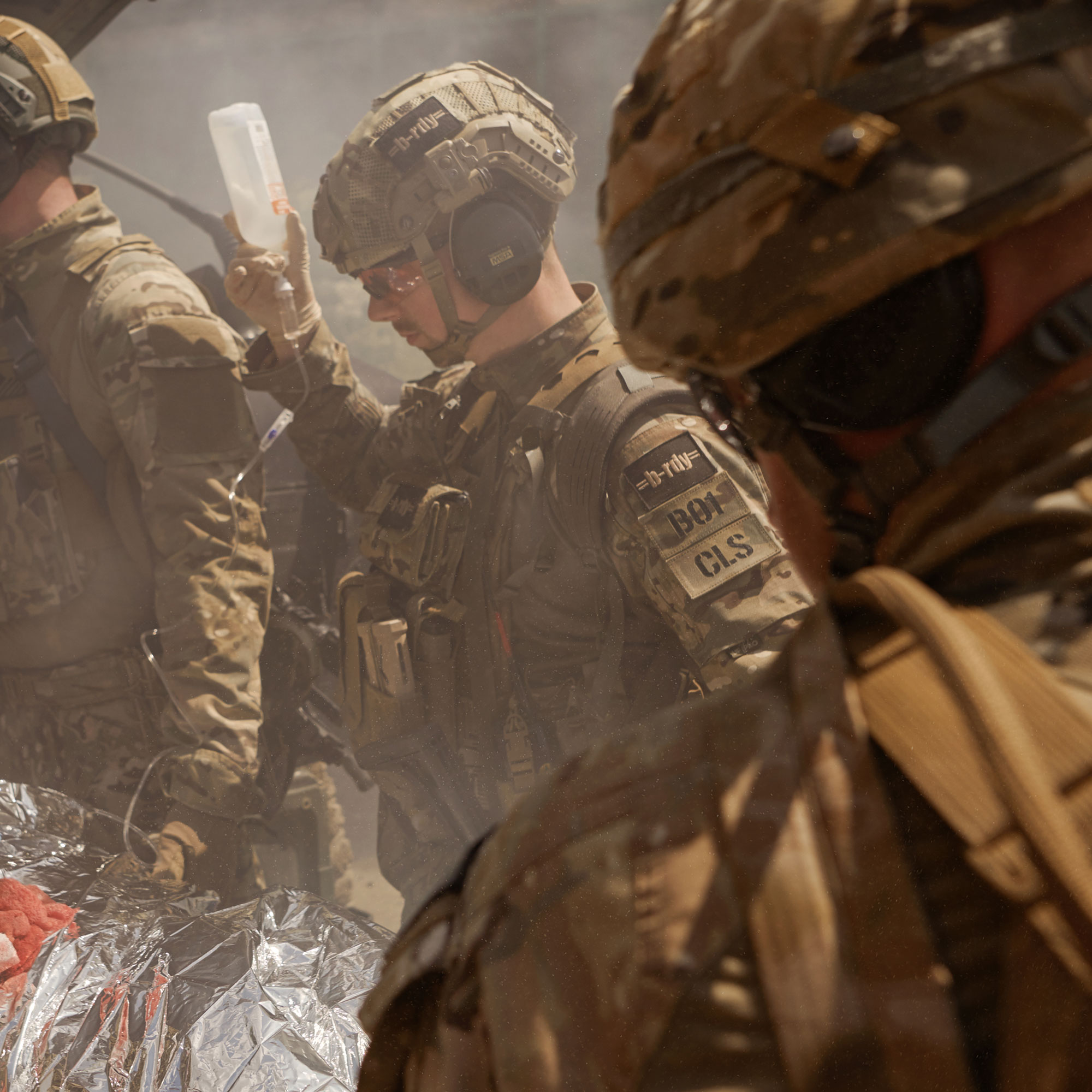
Prolonged Casualty Care (PCC) Course is designed for TCCC CLS and Medics who want to train need to provide patient care for extended periods of time when evacuation or mission requirements surpass available capabilities and/or capacity to provide that care.
B-rdy have long-term cooperation in training with the Elite-Lhenice Education Center and the Association of Tactical and Field Medicine Practitioners who, together with B-rdy practical approach to education, are guarantee the quality of the course.
The PCC guidelines are a consolidated list of casualty-centric knowledge, skills, abilities, and best practices intended to serve as the baseline clinical practice guidance (CPG) to direct casualty management over a prolonged period of time in austere, remote, or expeditionary settings, and/or during long-distance movements. These PCC guidelines build upon the standard of care for nonmedical and medical first responders as established by the Committee on Tactical Combat Casualty Care (CoTCCC).
The principles and strategies of providing effective prolonged casualty care are meant to help organize the overwhelming amount of critical information into a clear clinical picture and proactive plan regardless of the nature of injury or illness. The following steps can be implemented in any austere environment from dispersed small team operations in permissive environments to large scale combat operations to make the care of a critically ill patient more efficient for the medic and their team. These mimic the systems and processes in typical intensive care units without relying on technology while leaving the ability to add technological adjuncts as they become available. The following checklist is meant to emphasize some of the most important principles in efficient care of the critically ill patient.
The guidelines build upon the accepted TCCC categories framed in the novel MARC2H3-PAWS-L treatment algorithm, (Massive Hemorrhage/MASCAL, Airway, Respirations, Circulation, Communications, Hypo/Hyperthermia and Head Injuries, Pain Control, Antibiotics, Wounds (including Nursing and Burns), Splinting, Logistics). All procedures applied in the course are in accordance with the current TCCC (Tactical Combat Casualty Care) system. Even without prior completion of lower levels (NAEMT TCCC ASM or NAEMT TCCC CLS), students will acquire basic skills and expand them with more demanding techniques for controlling bleeding, securing airways, dealing with complications of torso injuries, shock therapy, securing the vascular system, immobilization techniques, and detailed patient examination.
During practical drills on models and live tissue, they will acquire skills used for advanced stabilization of trauma patients. A number of model situations during the day and night will help students prepare for the most common scenarios they may encounter in combat conditions, not only in the pre-hospital environment, but also in higher levels of care.
TCCC is especially designed for professional soldiers, armed security forces, active reserve members, and civilians interested in combat medicine. All procedures applied in the course are in accordance with the current TCCC (Tactical Combat Casualty Care) system and are based on practical experience gained by our instructors during their participation in foreign military operations.
TCCC CM course materials can be downloaded HERE.
MAIN BENEFITS
- 3 days practical training of the TCCC education
GEAR & EQUIPMENT
We can also to borrow you the proper equipment.
Mandatory equipment:
- A full gear equipment including a protection helmet (ballistic or bump)
- A gloves
- Eyes protection (ballistic glasses)
- A training rifle (airsoft, FX) on a quality sling
- Military shoes
- Knee protection
LAWS & CONDITIONS
The course is open for everyone with valid CLS/CM certification.
PAYMENT
Registration is mandatory. When you register for a course, you will receive a confirmation email and we will send you an invoice approximately 1 week before the event.
The course price includes the rental of all training facilities and equipment necessary for the entire course, the instructor and his assistants, manikins, and a NAEMT certificate. Other costs, such as food, accommodation, tactical medicine training manuals, transportation, ammunition, etc., are covered by the participant.
DOWNLOAD MATERIALS
Go to Materials page and download the printable targets and other materials for your training.
BASIC INFORMATIONS
| Tier | 1 – individual skills |
| Recomm. competence | CLS/Medical education degree |
| Course length | 3 days (36 hours) |
| Graduation | PCC Certificate |
| Graduation requirements | passing final exam |
| Course capacity | Class with 10 students |
| Language | Czech | English |
| Ranges | TBA |
| Price | CZK 12.000 (incl. VAT) |
COURSE GRADUATE PROFILE
A graduates have the skills to perform initial lifesaving care using TCCC guidelines and continue resuscitation, delineate roles and responsibilities, including naming a team leader. They have performed comprehensive physical exam and detailed history with problem list and care plan and they are able to record and trend vital signs, create a nursing care plan. They have a experience with a teleconsultation and telemedicine. The have skill to implement team wake, rest, chow plan, anticipate resupply and electrical issues. They went through periodic mini rounds assessments. Graduate has the skill to obtain and interpret lab studies, perform necessary surgical procedures and can prepare casualties for transportation or evacuation care with documentation for patient handover.
REFERENCES FROM OUR STUDENTS
TBA
GALLERY
VIDEOS & INSPIRATION – TBA